
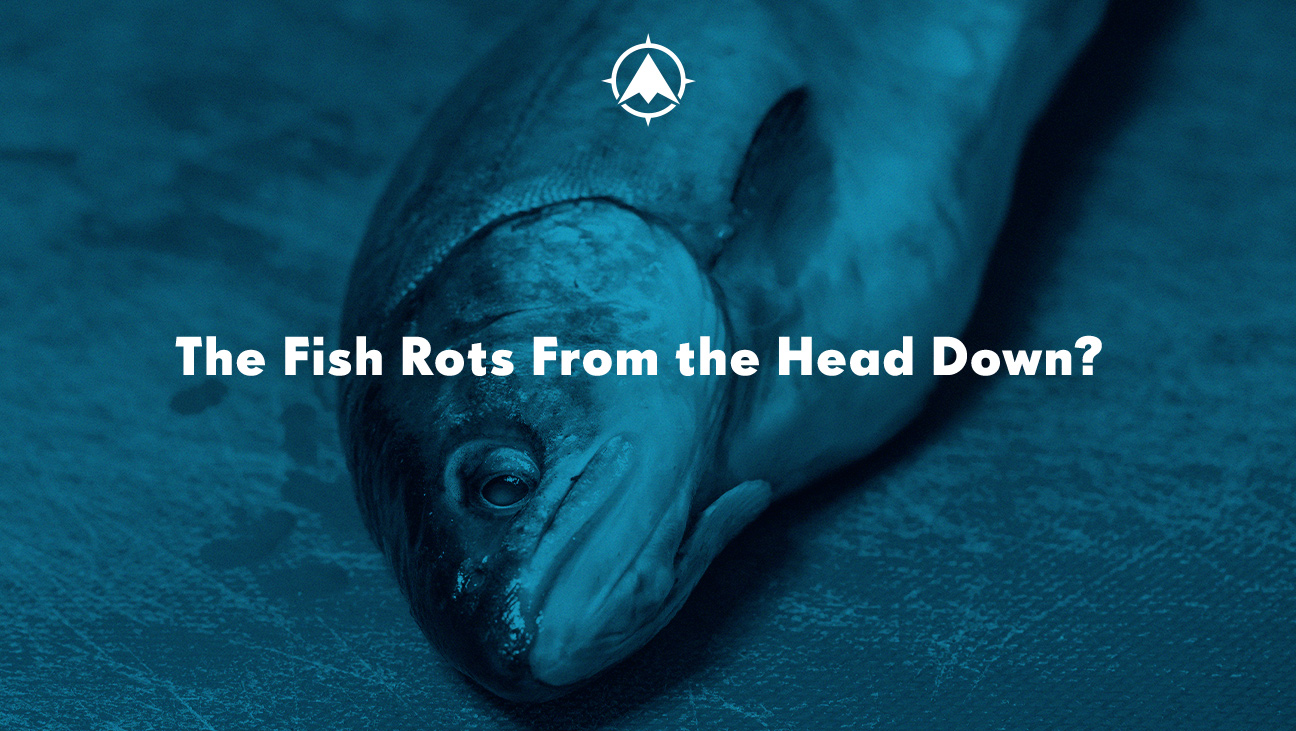
The fish rots from the head down. You’ve probably heard the expression before. It’s pretty common. And it’s also biologically inaccurate. Fish actually rot from the gut first…not the head. So, where did the proverb originate? There are a few possibilities: Turkey, China, England and Persia all reference variations of the expression (like “the fish stinks from the head”). But no matter where you find it, it’s a metaphor useful for financial services leadership training.
However, it’s worth looking closer at both the metaphor and the biological reality. Because both have important things to say about leadership.
The Fish Rots From the Head Down
This metaphor means that an organization falls apart due to poor leadership at the top. The top-level folks make the rules, set the culture and establish communication standards. They hold people accountable or they permit bad behavior.
Your team looks to you as their leader. They follow your example. The culture you create and the behaviors you value become the environment they work in and the behaviors they perform.
That means toxicity at the top does indeed spread down and infect your brand. (Remember brands are more cultural than collateral.)
The Fish Rots From the Gut First
There’s also truth in the biology of how a fish rots. Even if top-level leadership is excellent, bad leadership somewhere in the middle of the organization – in its proverbial cogs and gears – hollows you out.
Gut-rot leadership appears a few ways:
- Managers have technical prowess but lack soft skills/interpersonal skills
- Managers lack accountability for behaviors beyond numbers/metrics
- Managers’ actions create increased turnover at lower levels
Your middle managers are vitally important to your cultural health. They must become more than managers…they must become mentors. Don’t assume someone knows how to lead because they got a promotion. They don’t.
Prevent gut-rot leadership. Make sure you’re solid top to bottom.
Leadership is Cultural
At the end of the day, leadership can’t be something only the “bigwigs” do. It must be a practice for every member of staff. You want a leader at every desk.
But to get there, you need great exemplars at the top and in the gut of your organization. Build a culture of leadership using those two points as the linchpins of your strategy. How?
- Connect the head and the gut. Have the best top-level leaders mentor and uplift the middle managers. Your top managers likely crave further professional development and will welcome the opportunity to learn.
- Invest in financial services leadership training for your whole crew. Developing better leaders now saves you money on losses from bad leadership later.
- Have an accountability buddy. It’s easy for any leader to backslide over time, so have someone you trust to “check your homework.”
John Maxwell says “Everything rises and falls on leadership.” Make sure you have a leadership culture at all levels so your organization can fly sky high.
Of course, leadership skills are some of the hardest to teach, and it’s hard to find training your team actually enjoys. Book a free consultation, and start financial services leadership training that teaches those soft skills while engaging your team.
Frequently Asked Questions About Financial Services Leadership Training
Q: What does “the fish rots from the head down” mean for financial services?
A: In financial services, this leadership principle means that cultural and ethical failures (from compliance shortcuts to consumer relationship breakdowns) originate at the top. Senior leaders in banks, wealth management firms and insurance companies set the behavioral standards their teams follow. When that leadership is weak or misaligned, the dysfunction spreads downward and damages both culture and consumer trust.
Q: Can a financial services organization fail even when executive leadership is strong?
A: Yes. Even with solid C-suite leadership, poor management in the middle layers – branch managers, team leads, compliance supervisors – can hollow out an organization. This “gut-rot leadership” often shows up as technically proficient managers who can’t develop their people, drive up turnover or create accountability gaps that regulators and consumers eventually notice.
Q: What are the warning signs of bad middle management in a financial services organization?
A: Three red flags to watch for: managers who excel at hitting numbers but struggle to coach or retain their teams; managers who are held accountable only for production metrics, not behavior or culture; and managers whose teams show elevated turnover – a costly problem in an industry where consumer relationships sometimes follow the advisor, not the organization.
Q: How do financial services firms build a leadership culture at every level?
A: The most effective financial services leadership training connects top executives with middle managers through deliberate mentorship, not assumption. It combines soft skills development with role-specific accountability structures, and it treats leadership as an ongoing practice rather than a one-time training event. A leader-at-every-desk mindset is the goal.
Q: Why isn’t promoting a top producer the same as developing a leader in financial services?
A: Promoting your best advisor, analyst or loan officer into management is one of the most common mistakes in financial services leadership. Production skill and people leadership require entirely different competencies. Without targeted financial services leadership training, new managers default to what made them successful individually – which often undermines the team they’re now responsible for developing.